

With so many staking options and strategies out there, it’s easy to get overwhelmed. Staring at a staking APY is like seeing a single number on a map. You know the destination—passive income—but you have no idea about the route, how long it’ll take, or the stops along the way. A crypto staking calculator is your financial GPS for that journey.
It transforms an abstract Annual Percentage Yield (APY) into a tangible forecast of what you could actually earn. It moves way beyond simple math to show how your initial investment, lock-up period, and compounding frequency all work together to grow your assets. This guide will show you how to use one effectively to build a smarter, more predictable staking strategy.
What is Staking and Why Does a Calculator Matter?
At its core, crypto staking is the process of actively participating in transaction validation on a Proof-of-Stake (PoS) blockchain. By "locking up" your cryptocurrency, you help secure the network. In return, the network rewards you with new coins, generating a passive income stream.
But how much can you actually earn? Without a crypto staking calculator, stakers are essentially flying blind. You might underestimate the power of auto-compounding or miscalculate your net returns after validator fees. This leads to missed opportunities and disappointment.
A good calculator helps you:
- Visualize Your Growth: See how small, consistent rewards can snowball into something significant over time, especially when auto-compounding kicks in.
- Compare Different Strategies: Model a few scenarios before you commit. For instance, you can instantly see how a three-month lock-up period on a platform like StakeLedger.io might offer a higher yield compared to a flexible option for the same crypto.
- Set Realistic Goals: Understand all the variables that influence your earnings and set financial goals based on real data, not just wishful thinking.
- Identify Your Key Levers: Recognize which inputs—like the amount you stake or for how long—have the biggest impact on your final payout.
A crypto staking calculator isn’t just a math tool; it's a strategic planner. It lets you simulate your financial future before you put a single dollar on the line, making sure your staking activities align with your investment goals.
Ultimately, using a staking calculator is the first real step toward building a deliberate, effective passive income strategy. It empowers you to move from speculative guesswork to calculated growth. By providing this kind of clarity upfront, non-custodial platforms like StakeLedger.io make sure you start your staking journey with confidence, armed with a clear roadmap of your potential earnings.
The Engine Behind Your Earnings: Unpacking the Formulas
A crypto staking calculator isn’t magic—it's a powerful engine running on simple math. Once you understand the formulas, you move from just accepting a number to knowing how your passive income is generated. This is key to building a strategy you can feel confident about.
Let's start with the basics.
The Baseline Calculation: Simple Interest
The most straightforward way to forecast rewards is with a simple interest formula. This shows what you'd earn if rewards were paid out at the end of your staking period without being reinvested.
The formula is clean and simple:
Total Rewards = Principal Amount x Annual Percentage Yield (APY) x Time (in years)
So, if you stake 10 ETH at a 5% APY for exactly one year, the math looks like this:
10 ETH x 0.05 x 1 = 0.5 ETH in rewards
This gives you a clear starting point. But it misses the single most powerful wealth-building tool in staking: compounding. This is where a sharp crypto staking calculator, like the one from StakeLedger, proves its worth.
This diagram breaks down the three core inputs that drive every calculation.
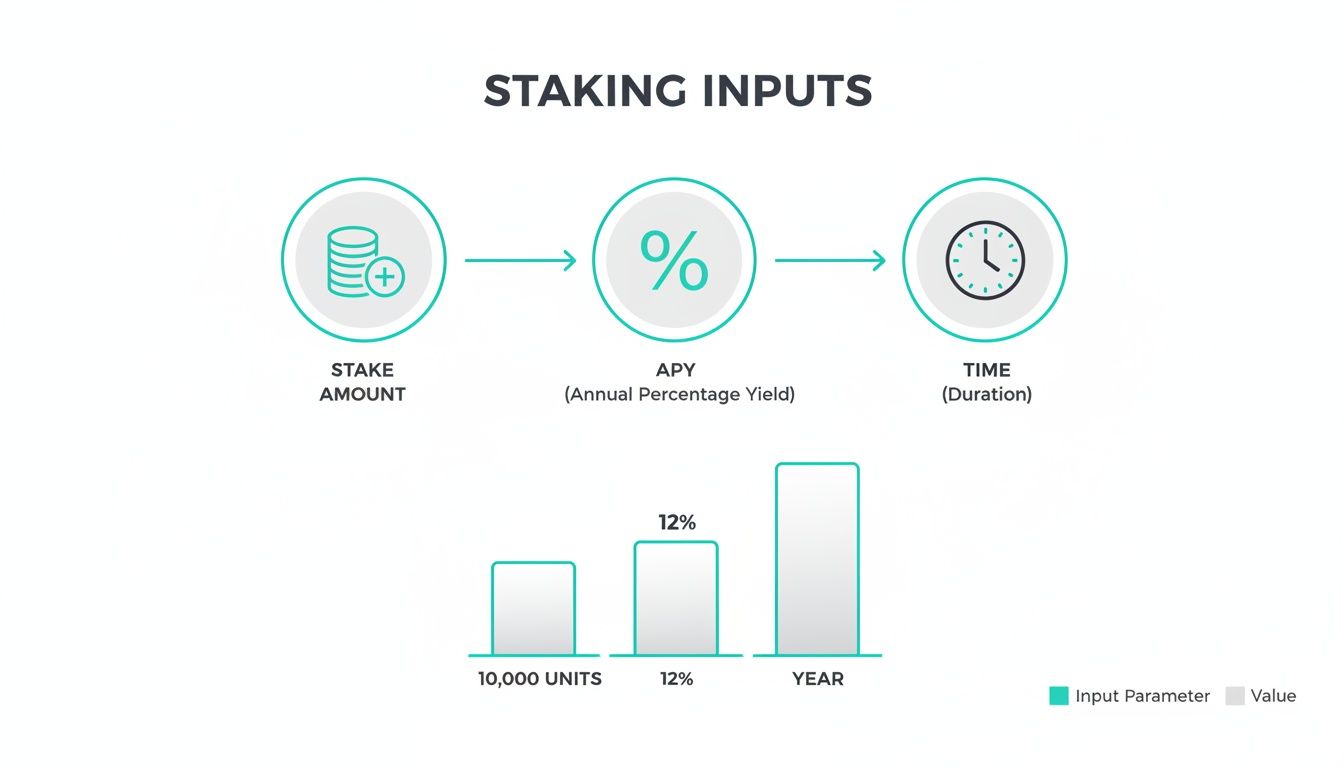
As you can see, your initial stake, the APY, and time are the fundamental levers that determine your returns.
The Game Changer: Compounding Interest
Compounding is the secret sauce. It's the process of reinvesting your rewards back into your principal stake, creating a snowball effect. Instead of just earning rewards on your initial amount, you start earning rewards on your rewards.
The formula for compound interest is a bit more involved, but it’s what captures this exponential growth:
Future Value = Principal Amount x (1 + (APY / n))^(n * t)
Here’s a breakdown of the new variables:
- n: The number of times rewards are compounded per year.
- t: The number of years you’re staking for.
Let's run our 10 ETH at 5% APY example again, but this time with monthly compounding (n = 12).
- After one year, your total becomes 10 x (1 + (0.05 / 12))^(12 * 1) ≈ 10.51 ETH.
- This means your total earnings are 0.51 ETH—a little more than the 0.50 ETH from simple interest.
While that difference seems small at first, it grows dramatically over longer periods. That’s precisely why a platform that offers auto-compounding, like StakeLedger, is so valuable. It handles this entire process automatically, ensuring you maximize your returns without manual effort.
Factoring in Real-World Variables
A truly useful calculator needs to go deeper by including other factors that impact what you actually take home.
The best calculators provide a complete financial picture. They don't just show you gross potential; they account for real-world variables like fees and tiered rates to give you a precise, actionable forecast of what you’ll actually keep.
These variables are non-negotiable for an accurate projection:
- Staking Fees: Validators and platforms charge a small percentage of your rewards. A good calculator automatically subtracts these fees to show you your true net profit.
- Tiered APY Bonuses: Many platforms, including StakeLedger, reward stakers with higher APY tiers for larger stakes or longer commitments. An advanced calculator applies these bonuses to your projection.
By folding these elements into its calculations, the StakeLedger calculator delivers a precise forecast that reflects your unique situation. It removes the guesswork and helps you build a strategy based on numbers you can trust.
Understanding the Levers That Control Your Returns
Think of projecting your staking earnings like mixing a track on a soundboard. Every lever you pull—your initial capital, the lock-up period, the compounding frequency—changes the final sound. Getting a handle on these variables is what separates passive participation from active, smart strategy.
A good crypto staking calculator lets you play with these levers in real-time, transforming a static APY figure into a dynamic system where you’re in the driver's seat. Let’s break down the most important factors.
The Variables You Directly Control
Your potential return is driven by a handful of key inputs you decide on before locking up a single token.
- Staking Amount (Your Principal): The more capital you put in, the larger your reward base. A calculator shows how a small bump in principal can dramatically change long-term growth.
- Annual Percentage Yield (APY): This is the engine of your returns. While APY can fluctuate, using a platform like StakeLedger ensures your calculations are based on the most current rates for assets like Ethereum, Solana, and Cardano.
- Compounding Frequency: A calculator shows you exactly how often your rewards get added back to your principal. StakeLedger automates this with auto-compounding, so your earnings snowball without you lifting a finger.
- Lock-up Period: Here, you're balancing yield with liquidity. Committing your assets for longer usually unlocks a higher APY. The StakeLedger calculator can instantly compare a flexible plan versus a 3-month lock-up, showing the financial upside of reduced liquidity.
External Factors That Influence Your Net Profit
Beyond what you control, other factors can tweak your final take-home earnings. A reliable calculator accounts for these automatically.
The need for a solid crypto staking calculator has exploded as institutional money floods the space. With Spot Bitcoin and Ethereum ETFs amassing over $115 billion in AUM, traditional investors are now hunting for yield. Globally, over $110 billion is now staked, a stunning 300% increase since 2023, largely because the infrastructure has matured. As institutions get serious, platforms are competing on features like StakeLedger’s flexible lock-ups (1 week to 3 months) and tiered yields that can boost APYs by up to 2% for larger deposits. Explore more insights on the state of the network.
Staking success isn't just about chasing the highest APY. It's about understanding the entire ecosystem of variables—from fees to tiered bonuses—and using a calculator to model a strategy that actually works for you.
Here are two critical external factors to watch:
- Staking Fees: Platforms and validators charge a small fee on your rewards. The StakeLedger calculator transparently deducts these fees, showing you the net profit you can expect.
- Tiered Rates: To reward commitment, platforms like StakeLedger offer better APYs for larger staking amounts. Our calculator automatically applies these tiered bonuses, giving you a precise forecast.
By understanding each of these levers, you can use a crypto staking calculator not just as a forecasting tool, but as a strategic dashboard to build a smarter, more profitable staking plan.
A Practical Walkthrough of the StakeLedger Calculator
Knowing the formulas is one thing, but putting a calculator to work is where the lightbulb moments happen. Let’s walk through the StakeLedger calculator step-by-step to turn abstract numbers into a concrete forecast for your staking rewards. We'll play with different assets, amounts, and lock-up periods to show you how your potential earnings can change in real-time.
Step 1: Selecting Your Asset and Staking Amount
First, pick which Proof-of-Stake asset you want to forecast. The StakeLedger calculator is packed with top networks like Ethereum, Solana, and Cardano. Once you choose one, the calculator instantly pulls in the current, live APY, so your projection is based on what’s happening right now.
Next, type in your Staking Amount. This is your principal. Don't be afraid to experiment. Start with a number you’re comfortable with, then adjust it to see how the projections shift. It’s the quickest way to see how your initial capital drives your potential growth.
This screenshot shows just how clean the interface is.
See how the projected earnings are displayed right away? That gives you an immediate snapshot of your potential returns.
Step 2: Experimenting with Lock-Up Periods and Tiers
This is where you get strategic. The StakeLedger calculator lets you toggle between different lock-up periods—like one week, one month, or three months. As you click between these, you’ll see the APY and your projected earnings change on the fly. This makes the classic trade-off between higher rewards and asset liquidity crystal clear.
For instance, a 3-month lock-up on Ethereum might offer a much juicier APY than a flexible one-week option. This instant feedback helps you make a smart decision that fits your financial goals.
What's more, the calculator automatically applies tiered rewards. If you enter a staking amount that bumps you into a higher APY tier, the tool will update your forecast to show that bonus. This transparency ensures you’re seeing the full picture.
A great crypto staking calculator doesn’t just do math; it visualizes strategy. By letting you adjust variables like lock-up periods in real-time, it shows you the direct impact of your decisions, turning a simple forecast into a powerful planning tool.
Step 3: Visualizing the Power of Auto-Compounding
Finally, the calculator’s projections have the magic of auto-compounding baked right in. That final earnings number reflects the exponential growth that kicks in when your rewards are automatically reinvested. While StakeLedger handles this for you in the background, the calculator is where you get to see its long-term impact spelled out.
Try playing with the time horizons. Compare the projected earnings over one month versus one year. That difference highlights how compounding builds momentum, turning small, steady gains into something substantial over time.
By following these steps, you can go from wondering about staking rewards to building a confident, data-driven plan. The StakeLedger calculator takes the guesswork out of the equation, giving you a clear, honest view of what your assets could achieve. Ready to see for yourself? Try the calculator now and start modeling your own staking strategy.
Beyond the Numbers: Risks to Consider
You've run the numbers through a crypto staking calculator and have a projection of what you could earn. That’s a fantastic first step. But every calculation is an informed estimate, not a promise etched in stone. To come out on top, you have to look past the numbers and understand the real-world forces that can affect your returns. A calculator is a planning tool, not a crystal ball.
APY Isn't Static—Neither Is Network Health
The biggest moving part in any staking calculation is the Annual Percentage Yield (APY) itself. While a calculator uses the current APY, that rate is constantly in flux. Here’s why:
- Pros: High APYs can generate significant passive income.
- Cons: A surge in network participation can drive the APY down for everyone. Your rewards are also linked to validator performance; a validator with poor uptime can lead to missed rewards or even slashing penalties.
This is why picking a platform like StakeLedger.io matters. We are committed to maintaining 99.95% uptime and only work with best-in-class validators to shield your earnings from performance hiccups.
The Trade-Off: Lock-Up Periods vs. Market Swings
Another critical piece is the lock-up period.
- Pros: Committing your assets for a longer stretch often unlocks a higher APY.
- Cons: It also means your funds are illiquid. If the market takes a nosedive while your crypto is locked, you can't sell or move your assets.
A crypto staking calculator will show you the shiny upside of a long lock-up, but your strategy has to account for the potential downside. It’s always a balancing act between chasing higher yields and respecting your own risk tolerance.
Your Staking Platform Is Your Partner
Finally, don't overlook the reliability of your staking provider. The platform's security and operational excellence directly affect the safety of your funds and the consistency of your rewards. This is where "Do Your Own Research" (DYOR) is your first line of defense. Staking with a non-custodial platform like StakeLedger means you retain control of your private keys, which significantly enhances your security compared to centralized exchanges.
Globally, the staking industry secures over $110 billion in assets. Platforms like StakeLedger support heavy hitters like Ethereum, Cardano, and Polygon. With Ethereum's staked supply hitting 28% (35 million ETH) and Solana attracting $25 billion with its 8% rewards, the opportunity is huge, but so is the need for a partner you can count on. YouHodler's analysis offers more great market insights.
A crypto staking calculator is a must-have for planning your moves, but your diligence in managing these outside risks will truly determine your success.
Building a Smarter Staking Strategy with Your Results
A crypto staking calculator gives you the data, but a winning strategy gives you the edge. Once you've run the numbers, the real work begins: turning those projections into a smart, resilient staking plan. This is where you move from simple forecasting to active strategic planning. Here are some actionable steps:
Create a Staking Ladder
Instead of putting all your capital into a single long-term lock-up to chase the highest APY, consider a staking ladder. This strategy involves splitting your funds across different timeframes. You might stake a portion for one week, another for one month, and the rest for three months. This gives you a balanced portfolio where you get higher yields from long-term stakes while still having regular access to some of your funds.

Diversify Across Networks for Resilience
Another cornerstone of a solid strategy is building a multi-chain portfolio. Relying on a single network is a recipe for concentrated risk. The StakeLedger platform is built for this, supporting a wide range of top Proof-of-Stake assets from Ethereum and Solana to Cardano and Avalanche. Spreading your stake across different networks creates a more resilient portfolio, smoothing out your earnings and protecting your capital.
From Projections to Performance Tracking
Your calculator forecast is the starting line. The real test is seeing how your actual earnings stack up against those initial numbers. This is where the StakeLedger dashboard becomes the perfect partner to the calculator, giving you a live, transparent view of your active stakes, rewards, and total earnings.
The journey from calculation to action is where a passive income strategy comes to life. A smart staker uses the calculator to set a course, then uses their dashboard to navigate, making adjustments as needed to stay on track.
By regularly comparing your dashboard’s live data with your calculator’s forecast, you can:
- Validate your strategy: Are your chosen assets delivering the returns you expected?
- Spot opportunities: Notice which assets are outperforming and consider reallocating funds.
- Stay ahead of the curve: Keep a close eye on APY changes and make proactive decisions.
With global staked assets past $110 billion and institutions jumping in for steady yield, the tools for smart staking are more important than ever. Discover more on institutional staking trends.
A crypto staking calculator is your planning tool. Your success comes from how you apply that knowledge. Move from calculation to action on the StakeLedger platform and start building your passive income stream with confidence.
Questions People Ask About Staking Calculators
Even with a great tool, you’re bound to have questions. Let's tackle some common ones to help you build confidence in your forecasts.
Just How Accurate Are These Things?
A staking calculator is incredibly accurate at doing the math based on what you tell it. The catch? The numbers you put in, especially the Annual Percentage Yield (APY), aren't set in stone. The APY can and will change with network conditions.
Think of the calculator as a high-powered flight simulator. It shows you exactly what should happen under specific conditions, but it can’t predict future weather. Platforms like StakeLedger pull in live APY data to give you the most current estimate, but it's still a projection, not a promise.
Does the Calculator Actually Factor in Compounding?
It absolutely has to. Showing you the magic of compounding is one of a good calculator's main jobs. A simple interest tool shows a flat rate, but a real staking calculator like StakeLedger's models how your rewards get rolled back into your principal, earning rewards of their own. This is the snowball effect that creates serious growth over time.
Can I Use the Same Calculator for Every Coin?
You could, but you shouldn't. Every Proof-of-Stake network has unique reward rates and conditions. This is why using an integrated calculator on a platform like StakeLedger is your best bet. It’s already set up with the correct, real-time data for assets like Ethereum, Cardano, and Solana, saving you from costly mistakes.
What Are the Biggest Mistakes People Make?
The most common mistakes are:
- Treating a projection like a guarantee. Remember, the APY will fluctuate. Use the calculator as an informed estimate.
- Forgetting about fees. A good calculator will include validator or platform fees, showing you the net returns you actually keep.
- Ignoring lock-up periods. Chasing a high APY might mean locking your funds for a long time, killing your flexibility.
A smart staker uses the calculator to find that sweet spot between maximum yield and the amount of liquidity they're comfortable with. It’s a strategy tool, not just a numbers machine.
By steering clear of these pitfalls, you can turn a simple calculator into a powerful part of your decision-making process.
Ready to stop guessing and start planning? The StakeLedger platform provides the tools you need to forecast, execute, and track your staking strategy with clarity. Explore our advanced crypto staking calculator and dashboard to see how you can build your passive income stream today. Begin your staking journey at https://stakeledger.io.
Article created using Outrank