
With so many crypto staking options and strategies out there, it’s easy to get overwhelmed. Is staking crypto safe? The honest answer is that it can be a reliable way to grow your digital assets, but you absolutely cannot treat it as a risk-free investment. Think of it less like a speculative trade and more like a long-term strategy that rewards participation.
Success in staking hinges on understanding the risks involved and making informed choices. This guide is designed to give you that clarity.
Your Guide to Staking Without Getting Rekt
The safety of your staked crypto isn't a simple "yes" or "no" question. It comes down to the choices you make—from the blockchain you support to the platform you use. With staking becoming a core part of many crypto portfolios in 2025, understanding these nuances is more critical than ever.
This guide is about building informed confidence. We'll walk through the five make-or-break risks every staker needs to understand before locking up a single coin:
- Market Volatility: The unavoidable risk that your staked asset's price could drop.
- Lock-Up Periods: When your crypto is committed to the network and cannot be immediately sold.
- Validator Reliability: The risk of delegating to an underperforming or untrustworthy operator.
- Slashing Penalties: The network's way of punishing bad or malicious validators.
- Smart Contract Bugs: Hidden flaws in a protocol's code that could be exploited.
By breaking down each of these, you’ll have a solid framework for making staking decisions that align with your financial goals and risk tolerance.
Why You Can't Afford to "Set It and Forget It"
Staking is more than just a passive income stream; it's an active participation in securing a blockchain. When you stake, you’re putting your capital to work to validate transactions and signal your confidence in a project's future. Going in blind not only puts your assets on the line but also misses the opportunity to optimize your strategy for better returns and security.
This is where a platform like StakeLedger becomes essential. Our mission is to cut through the complexity, giving you the tools and transparency to navigate staking safely. For example, our dashboard provides clear reward projections and tracks validator performance in real-time, helping you solve the pain point of performance measurement so you’re always in control.
Once you grasp the mechanics and the risks, staking shifts from a speculative gamble to a calculated financial move. This guide is your first step toward getting that clarity.
The Five Big Risks of Staking You Can't Afford to Ignore
Before you jump into staking, it's critical to know what you're up against. While it’s often pitched as a safer alternative to the wild west of crypto trading, staking still has its own set of challenges. Getting a handle on these five core risks is the first step to building a smart, resilient staking strategy.
Let's break them down one by one, so you can see exactly what you’re dealing with.
1. Market Volatility: The Elephant in the Room
This is the most obvious risk and one that impacts every corner of the crypto world. The price of the assets you stake will go up and down. It's a simple fact. You could be earning a fantastic 5% APY in staking rewards, but if the token’s price drops by 20%, your portfolio’s value in dollars is still down.
Staking grows the quantity of tokens you hold, not its fiat value. Think of it this way: you’re accumulating more of an asset you believe in for the long haul. If that asset’s value goes to the moon, your compounded rewards will feel like rocket fuel. But staking won't save you from a bear market.
2. Lock-Up Periods: The Golden Handcuffs
Many networks require you to lock your assets for a set period to participate in staking. This commitment helps secure the network, but it can be a real nail-biter for you. It’s like putting your money in a certificate of deposit (CD) at a bank—you commit for a term to earn a better rate, but your cash is tied up.
Imagine the market starts to tank, and every instinct is telling you to sell. If your funds are locked, you can't. You’re forced to sit on the sidelines and watch. This lack of liquidity is a trade-off you have to be comfortable with before you commit.
Key Takeaway: Lock-up periods force you to balance your desire for higher rewards with your need for quick access to your funds. It’s a classic risk vs. reward dilemma.
This is where having a platform that provides flexibility makes a huge difference. While some exchanges offer rigid staking terms, StakeLedger helps you manage this risk by providing flexible lock-up options on certain assets. This allows you to tailor your strategy to your personal comfort level with risk and liquidity.
This infographic shows how all these risks fit together.
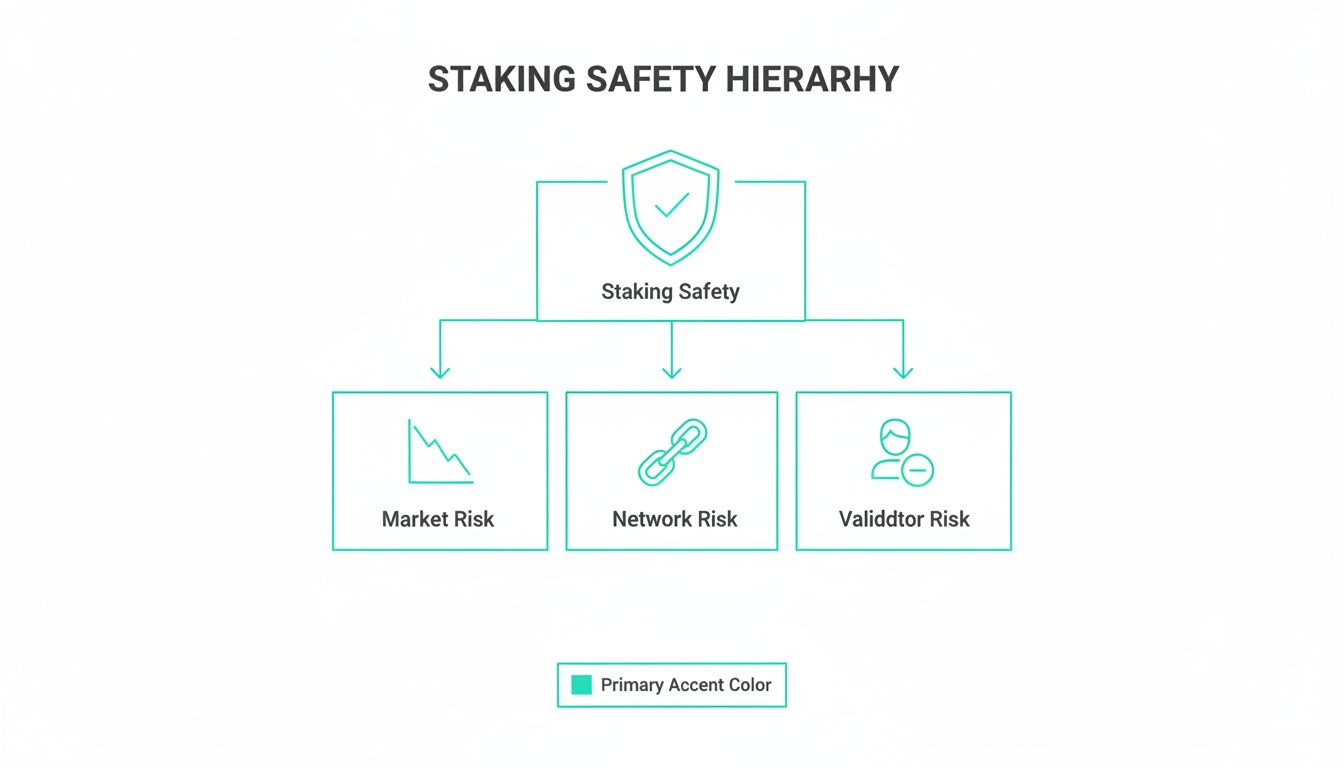
As you can see, true safety means looking at the full picture—from the market all the way down to the individual validator you choose.
3. Validator Risk: Who Are You Trusting?
When you delegate your crypto, you’re picking someone to represent you on the network. A validator is responsible for doing the work that earns you rewards. A bad choice can hurt your returns, mainly in two ways:
- Lousy Performance: If a validator's equipment is constantly offline or slow, they'll miss out on validating blocks. Fewer blocks validated means fewer rewards for you. It's that simple.
- Getting Slashed: This is the big one. If a validator acts maliciously or makes a major technical mistake, the network can penalize them by "slashing"—confiscating a portion of their staked crypto (which includes yours).
Slashing is rare for reputable validators, but it's a real threat. The more common issue is just picking a lazy or incompetent validator and missing out on rewards you should have earned.
4. Slashing Penalties: The Network's Hammer
Slashing is how a Proof-of-Stake network keeps everyone honest. It's a massive financial deterrent against bad behavior. A validator can get slashed for two main reasons:
- Serious Downtime: Being offline for so long that they fail to do their job.
- Double Signing: A malicious act where they try to approve two different blocks at the same time, threatening the integrity of the entire blockchain.
While it sounds terrifying, your actual risk of being slashed is incredibly low if you stick with professional staking services. Top-tier platforms like StakeLedger run on enterprise-grade hardware with 99.95% uptime guarantees and backup systems designed to prevent these kinds of failures, making this a managed risk.
5. Smart Contract Vulnerabilities: The Code Can Break
This risk is most common in liquid staking or DeFi protocols that rely on smart contracts to manage funds. A tiny, undiscovered bug in the code can be a backdoor for a hacker to drain every last token.
Think of it as a high-tech bank vault with a hidden flaw in its design. To an outsider, it looks impenetrable, but a clever thief could find the one weak spot. This is why you should only use platforms that have been through multiple, rigorous security audits from trusted third parties. Sticking to non-custodial staking, where you never hand over your private keys, also dramatically reduces this risk because the smart contract never has full control of your assets.
How Lock-Up Periods Affect Your Staking Strategy
Lock-up periods are one of the most misunderstood parts of staking. Many people see them as a major downside, but they're actually a core piece of how blockchains stay secure. If you manage them right, they can even become a strategic advantage.
Think of it like a term deposit at a bank—you agree to leave your money untouched for a while, and in exchange, you get a predictable return. This commitment helps stabilize the network by making sure enough validators are always online and doing their job.
But there's a trade-off, and it introduces a big risk: illiquidity. If the market suddenly tanks and your assets are locked, you can't sell. This is the main reason some investors get nervous, asking if staking is really safe when their funds are out of reach.

Native Staking vs. Liquid Staking
When it comes to lock-ups, not all staking is created equal. Your two main paths are native staking and liquid staking, and each handles liquidity very differently.
- Native Staking: This is the direct route, where you lock your assets right on the blockchain protocol itself. It's often the most secure way to participate and can bring the highest rewards, but it usually comes with the strictest lock-up and unbonding periods. For some assets, getting your tokens back can mean waiting several days after you decide to unstake.
- Liquid Staking: This approach offers a workaround for the lock-up problem. You give your assets to a third-party protocol, which stakes them for you and issues a derivative token in return (like stETH for Ethereum). This new token represents your staked position and can be traded or used in DeFi, giving you instant liquidity.
While liquid staking neatly solves the illiquidity puzzle, it adds a new risk to the board: smart contract vulnerabilities. You're now trusting that the protocol's code is perfect, which is never a guarantee.
Using Lock-Up Periods to Your Advantage
Instead of seeing lock-ups as just a negative, a smart investor can use them strategically. The secret is to align the lock-up time with your own financial goals and comfort with risk. A longer lock-up often means a higher yield, rewarding you for your long-term belief in the network.
This is where a platform built for flexibility changes the game. While some networks force you into rigid, non-negotiable terms, StakeLedger turns this risk into an opportunity. We give you flexible lock-up options, like 1 week, 1 month, or 3 months. This lets you:
- Balance Yield and Liquidity: Pick a shorter term if you think you'll need your funds soon, or go for a longer one to maximize your APY when you're in it for the long haul.
- Create a Staking Ladder: Just like people do with bonds, you can stagger your stakes across different lock-up periods. This ensures a piece of your portfolio is always close to its unlock date, giving you regular liquidity while the rest keeps earning rewards.
With StakeLedger, you don't have to make an all-or-nothing choice between earning rewards and keeping access to your money. Our platform puts you back in the driver's seat.
The Big Picture on Liquidity: Lock-up periods can tie up your assets for a bit, but they rarely cause a permanent loss of capital by themselves. In fact, they often signal strong network demand and security. For instance, Ethereum's validator entry queue swelled to 2.3 million ETH in late 2025, creating wait times of around 40 days due to massive institutional interest. This temporary "liquidity squeeze" didn't hurt stakers' principal; it just highlighted the network's strength and solid yield potential. Read the full analysis on how network demand impacts staking liquidity.
Across different Proof-of-Stake chains like Cardano and Polkadot, lock-up terms vary from a few days to several weeks. By understanding these details and using a platform with adaptable options, you can turn a potential risk into a key part of your crypto wealth-building strategy.
Are Slashing Penalties a Real Threat?
The word "slashing" is enough to send a shiver down any staker's spine. It’s the ultimate penalty in a Proof-of-Stake network, where a validator gets punished for bad behavior by having a slice of their staked crypto—and by extension, yours—forcibly taken away. It sounds harsh, and that's by design.
But let's put this risk into perspective. Slashing isn't something that happens because of a minor hiccup. It’s the network’s immune system kicking in to fight off two major threats: genuinely malicious attacks (like a validator trying to approve fake transactions) and catastrophic incompetence (like a validator disappearing offline for days on end).
For any reputable, professionally run validator, the odds of a slashing event are incredibly slim. The real problem for an individual staker is sorting through the noise to find those top-tier operators in the first place.
How to Vet a Validator Like a Pro
If you're staking on your own, picking the right validator is the single most important decision you will make. Think of it like choosing a fund manager for your portfolio—their performance and reliability directly dictate your returns and safety. A bad pick can mean missed rewards or, in the worst-case scenario, getting slashed.
Here’s a practical checklist for sizing up potential validators:
- Check Their Uptime History: You’re looking for a rock-solid track record of 99% uptime or higher. Anything less is a red flag that they're frequently offline, missing chances to validate blocks and shrinking your rewards.
- Analyze Their Commission Fees: Validators charge a fee on your rewards for their service. While a 0% commission might look tempting, it can signal an unreliable or unsustainable operation. A reasonable fee, usually between 5-10%, shows they’re serious about maintaining top-notch infrastructure.
- Gauge Their Community Standing: A great validator is usually a known and trusted entity within the network's community. Check out their website, see how they engage on social media, and look for their involvement in governance discussions. A strong reputation built over time is one of the best indicators of reliability.
Slashing is rare but real. On Ethereum, which has over 36 million ETH staked, a validator can lose their entire 32 ETH stake for severe offenses. Yet, even during major network events like the Prysm client bug in late 2025, widespread slashing was avoided, showing how robust these systems are. The key takeaway is that with proper validator selection, this risk becomes almost negligible for the average delegator. Learn more about how PoS networks handle risk.
The Smarter Way to Handle Validator Risk
Let’s be honest: doing all that due diligence yourself is a ton of work. It demands technical know-how, constant monitoring, and the ability to make sense of complex performance data. This is exactly why a platform like StakeLedger is such an essential tool for anyone serious about staking safely.
Instead of throwing you in the deep end to vet validators alone, we take care of the entire process. Here’s how StakeLedger turns validator risk from a major headache into a solved problem:
- Pre-Vetted Professional Validators: We only work with institutional-grade validators who pass our stringent requirements for performance, security, and reliability. You don't have to spend weeks researching; you just delegate to our secure, professionally managed operation.
- Monitored Infrastructure with 99.95% Uptime: Our entire system is built on enterprise-level hardware with multiple redundancies and fail-safes. This setup ensures your stake is always online and earning, dramatically minimizing exposure to downtime penalties.
- Outsourcing Your Due Diligence: When you stake with StakeLedger, you’re effectively handing off the hard work of due diligence to our team of experts. We continuously monitor our validator partners to make sure they stick to our high standards, protecting your assets and keeping your rewards optimized.
To make this even clearer, here’s a quick checklist showing how you can tackle common risks, and how we help.
Staking Risk Mitigation Checklist
This simple checklist outlines the best practices for minimizing the most common risks you'll face as a staker.
| Risk Factor | Best Practice for Mitigation | How StakeLedger Helps |
|---|---|---|
| Validator Slashing | Select validators with a perfect or near-perfect historical record and strong community trust. | We only partner with pre-vetted, institutional-grade validators with proven track records, virtually eliminating this risk for you. |
| Downtime Penalties | Choose validators with a public uptime history of 99% or higher and redundant infrastructure. | Our infrastructure guarantees 99.95% uptime, ensuring consistent reward generation and minimizing missed opportunities. |
| High Commission Fees | Compare validator fees and avoid those that are unusually high or suspiciously low (0%). | Our fees are transparent and competitive, structured to sustain high-performance operations without eating into your returns. |
| Poor Performance | Continuously monitor your chosen validator’s performance and be ready to redelegate if it drops. | We handle all the continuous performance monitoring, ensuring your stake is always with top-performing validators. |
By choosing a non-custodial platform that manages validator selection and monitoring for you, you sidestep one of the biggest and most complicated risks in staking. It lets you focus on your high-level strategy while we handle the technical heavy lifting, making your staking journey both safer and more profitable.
Custodial vs. Non-Custodial Staking: Which Is Safer?
When you decide to stake, one of the first and most critical choices you'll face is between custodial and non-custodial staking. This decision really boils down to a classic trade-off: control versus convenience. Getting this right is fundamental to keeping your assets secure for the long haul.
Custodial staking, the kind you'll typically find on big centralized exchanges, works a lot like a traditional bank. You hand over your crypto, and they handle everything else. It's simple and hands-off, but it introduces a major vulnerability: counterparty risk. You're putting your complete trust in a third party to manage your funds, stay solvent, and not get hacked.
Non-custodial staking, on the other hand, is like keeping your cash in your own personal safe. You always hold onto your private keys, meaning you never give up ownership of your crypto. You simply delegate your staking rights to a validator, but your assets never, ever leave your wallet.
Why Non-Custodial Is the Smarter Choice for Security
While the ease of custodial platforms is tempting, the non-custodial model offers a far more robust level of security and peace of mind. It all comes back to a core principle in crypto: Not your keys, not your crypto. When you stake on an exchange, you're exposed to risks totally outside of your control, like the exchange freezing withdrawals or suffering a catastrophic breach.
Non-custodial staking neatly sidesteps this entire layer of risk. Your assets stay in your wallet, protected by your own security practices. This self-sovereignty is the very heart of decentralization and, frankly, the safest way to participate in these networks.
This is exactly why StakeLedger is built entirely on a non-custodial framework. We firmly believe you should never have to compromise on security just to earn rewards. Our platform is designed to give you the best of both worlds:
- Ironclad Security: You maintain complete control over your private keys at all times.
- User-Friendly Experience: Our dashboard makes staking simple and transparent, even if you're just starting out.
- Professional Infrastructure: You get to use our pre-vetted, high-performance validators without ever handing over ownership of your assets.
In a recent clarifying statement, the SEC Staff noted that self-custodial staking arrangements—where the asset owner retains ownership and control of their private keys—are viewed as administrative or ministerial activities. This distinction reinforces the idea that non-custodial staking is a direct participation model, fundamentally different from handing assets over to a discretionary manager.
Custodial vs. Non-Custodial Staking at a Glance
To make the choice even clearer, let’s put these two approaches side-by-side. The differences have massive implications for the safety of your crypto.
| Feature | Custodial Staking (e.g., Centralized Exchange) | Non-Custodial Staking (e.g., StakeLedger) |
|---|---|---|
| Asset Control | You hand over your private keys to a third party. | You always maintain full control of your private keys. |
| Primary Risk | Counterparty risk (exchange hacks, insolvency, frozen funds). | Technical risks (slashing, downtime), which can be minimized. |
| Security Model | You trust the platform's centralized security measures. | You control your own security, removing the third-party risk. |
| Transparency | Often a "black box"; validator performance is not always clear. | Full transparency into validator performance and reward generation. |
| Ideal For | Beginners prioritizing maximum convenience over control. | Stakers who prioritize security, ownership, and transparency. |
Ultimately, with a non-custodial platform like StakeLedger, you don’t have to pick between a professional, managed experience and the fundamental security of owning your assets. We provide the tools, infrastructure, and transparency you need to stake with confidence. It’s simply the smarter, safer way to earn rewards without compromise.
A Practical Checklist for Safe Staking
Knowing the risks is half the battle, but having a solid plan is what actually keeps your crypto secure. Think of this as your pre-flight checklist before you commit your assets. Following these steps will help you sidestep common pitfalls and build a resilient staking strategy.
Step 1: Pick the Right Asset for You
Your first move is deciding what to stake. Not all Proof-of-Stake networks are built the same—each has its own unique rules, reward rates, and level of maturity.
Before you jump in, ask yourself a few honest questions:
- Does this project's long-term vision actually match my own investment goals?
- Am I okay with its specific rules, like how long it takes to unstake (the "unbonding period")?
- Is the network well-established and battle-tested?
A platform that gives you plenty of choices is a huge plus here. For instance, StakeLedger supports over 12 top-tier networks like Ethereum, Solana, and Cardano. This lets you compare them side-by-side and find the one that fits your strategy like a glove.
Step 2: Vet Your Platform and Validators
Who you stake with matters. A lot. Your choice of platform and validator is where risks like slashing and poor performance become very real. Always, always prioritize non-custodial platforms—the kind where you, and only you, hold your private keys.
Your main goal here is simple: find a platform with professional-grade infrastructure that doesn't force you to hand over ownership of your assets. Look for non-negotiables like a 99.95% uptime guarantee and pre-vetted validators, which is exactly what StakeLedger provides for serious stakers.
Step 3: Spread Your Bets (Diversify!)
You've heard it a million times, but it’s true: never put all your eggs in one basket. Spreading your stake across different assets and networks is a core principle of managing risk. If one ecosystem hits a rough patch, a diversified portfolio means your entire staking operation won't get wiped out.
For example, you could stake some of your funds in a heavyweight like Ethereum for its stability, while putting another portion into an up-and-comer like NEAR to capture potentially higher growth. The StakeLedger dashboard makes it dead simple to manage a diversified portfolio from one clean interface.
Step 4: Run the Numbers—Rewards and Fees
You need total clarity on what you can expect to earn and what it's going to cost. Use tools to get a realistic picture of your net returns after all fees are taken out. Vague promises of crazy high APYs are a massive red flag; you need precise calculations.
StakeLedger's reward calculators do just that, giving you clear, transparent projections based on what’s happening on the network right now. Our fee structure is completely straightforward, so you know exactly what you’ll earn with no hidden surprises.
Step 5: Stay Plugged In
The crypto world moves at lightning speed. Network upgrades, shifting reward rates, and big market moves can all throw a wrench in your staking strategy. Staying informed is how you adapt and make smart decisions when it counts.
Set up alerts to keep you ahead of the curve. StakeLedger, for example, has email alerts that ping you when APYs change or new assets are listed, ensuring you never miss a key update. It's a small step that transforms passive income into a proactively managed investment, keeping you firmly in the driver's seat.
Staking Safety: Your Questions Answered
Diving into the world of crypto staking always brings up a few questions. It's smart to be curious about where your assets are going and how they're being protected. Let's tackle some of the most common concerns stakers have right out of the gate.
Can You Lose All Your Money Staking Crypto?
It’s extremely unlikely you’d lose everything just from the act of staking itself. While the dollar value of your crypto can always drop due to market volatility, the biggest direct risk to your staked tokens is something called slashing.
Slashing is a penalty for bad behavior by a validator, but it's rare, usually only takes a small portion of staked assets, and is reserved for serious issues. When you use a professional, non-custodial platform that partners with carefully vetted validators, this risk becomes almost zero. The far more realistic risk is the market price of your tokens going down, not your actual tokens disappearing.
Is Staking Safer Than Trading?
In a word, yes. Staking is a long-game strategy. You're earning predictable rewards by helping to secure a blockchain network you believe in for the long haul. This is fundamentally different from short-term trading, which is all about guessing volatile price swings correctly.
Think of it this way: staking is like earning a yield on an asset you want to hold anyway. Trading is an active, much higher-risk game of trying to time the market perfectly.
The Bottom Line: Staking is built for steady, long-term growth by participating in a network’s security. That makes it a fundamentally less risky activity than trying to day trade your way to profits.
How Does StakeLedger Protect My Assets?
At StakeLedger, we build your security on two unshakable pillars: you stay in control, and we provide rock-solid infrastructure.
First, our platform is strictly non-custodial. This is a huge deal. It means you—and only you—hold your private keys. Your assets never actually leave your wallet, which completely erases the counterparty risk you face on centralized exchanges where they hold your crypto for you.
Second, we run a secure, professionally managed infrastructure with 99.95% uptime. This keeps validator performance high and dramatically cuts the risk of downtime penalties or slashing. With StakeLedger, you get expert-level security and optimized rewards, all while keeping full ownership of your crypto.
So, is staking crypto safe? When done correctly, with the right knowledge and tools, it absolutely can be. The key is to manage the known risks—market volatility, validator performance, and liquidity—through careful planning and the use of a secure, non-custodial platform. By prioritizing control and transparency, you transform staking from a leap of faith into a strategic part of your digital asset portfolio.
Ready to stake with real confidence? The StakeLedger dashboard provides the tools and transparency you need to grow your assets without giving up control. Start your safe staking journey today.
Article created using Outrank